Sunday, 20 January 2013

While I am Lay Recovering

Shalom:
Right now, Mark and I  are at Mark's parents' doing laundry.
We are going through a very difficult time, so for those who do, I ask for your prayers.
But when I am home, laying in bed, trying to get well, I am either sleeping or reading.
I return to one of my favourite books, Hinds Feet On High Places.
In this most difficult place in our lives, I myself returning to the story of Much Afraid, servant of the Good Shepherd.
Much Afraid longs for the day she is able longer fellowship with the Shepard, longs for the day her crooked feet and mouth are made straight and whole. She dreads marriage to her cousin Craven Fear, who delights to abuse her.
Sharing the desire of her heart with the Shepard one day, He surprises her that He too longs for her healing and offers her the change to be made whole.
But it wouldn't be a Benny Hinn miracle; where she is slapped silly and someone man cries "HEAL."
No, she, Much Afraid must do the work for her feet to be transformed into "hind's feet." To do some, she would have to walk the path of the hind and face and overcome the fears that whole her back.
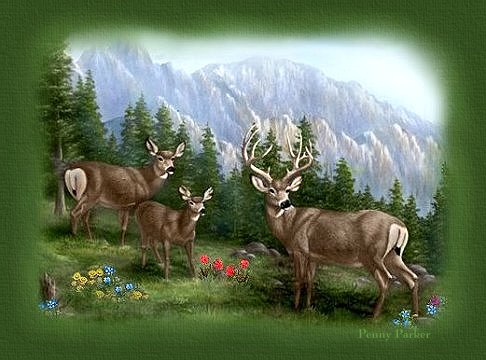
 Deer main graphic for Hinds' Feet on High Places - Higher Ground Our life of faith is liken to the path that the deer and hind travel. In order to take those breathtaking leaps, they must learn to leap over the stones and branches along their path. A young buck is insecure and nervous when taking those first leaps. But he has the best teachers in his parents, who show him how it is down, First the dad takes son to easy paths, easy branches and rocks to jump over. As his legs get stronger, the young buck is able to take on steeper paths with ease,
It is the reason we go through trials, to strenghten our faith muscles so we can leap over the stumping blocks that are thrown in our path.
The past few days, I have found myself battling the rise of my blood pressure, the stress that briefly left our lives, returning into weeks of our move and has settled in.
So as I recover, this is a good time to revisit my friend Much Afraid and the Shepherd.
This is a rather steep path.

Slow Recovery

Shalom:
Well, friends, I am still alive.
Though there are times I wonder.
Friday morning as the sun rose, so did the pain in my head. Having had a headache all week, I knew it as blood pressure, the stress in my life continues.
Fearing I was heading for another blood pressure crisis, when Mark came home, I had him check my blood pressure.
And it was as I feared, quite high.
I wasn't able to reach my doctor, she had left for the day, but Mark's doctor was free and willing to see me if we could get there quickly.
Once there, I was tested for and found to indeed have the flu. And was told my blood pressure medication would be increase to help get my pressure back to normal.
So I returned home with medication for the flu, orders to take in plenty of fluids which includes chicken soup and orange juice and to bed rest, for that I can fully recover from the flu and get rid of the stress.
Of course, that is easier said that done.
So I have been doing as the doctor said, Monti resting next to making sure I obey doctor's orders.
And though I am receiving excellent care, I still feel like a truck hit me.

Wednesday, 16 January 2013

The Flu Comes to Visit

Shalom:
I had plan to do a follow up on my last post, but since then, I have been hit hard with the Flu. A few days ago, I thought I was doing better. But last night, it doubled back.
So until I am back at the keyboard, everyone remain well and happy.
Blessings to all,
Laini

Monday, 7 January 2013

The Invisible Thread.

Shalom:

The Invisible Thread  is the title the book on top of my got to get list. It is the amazing true story of Laura Schroff and a then eleven year old boy by the name of Maurice.
I only heard about this story on the Mike Huckabee Show over this past weekend, when Mr. Huckabee interviewed Laura and Maurice...
Like so many,  Laura Schroff brushed by a young panhandler on a New York City corner one rainy afternoon, but then she stopped and  turn back. Laura said she had never seen a child pan handle before. Instead of giving him change, she took the boy to lunch at the McDonald’s across the street that day.As the story goes, she continued to go back, again and again for the next four years until both their lives had changed dramatically. Once Laura asked what could she do for him. Maurice asked for a brown papered bag lunch, because that bag was filled with lunch; that someone cared about him enough to make him lunch.I sat there, crying, for well I remember watching my mother making lunch for my sister and I. How I would draw on my paper bag as I ate my sandwich. While my son was enrolled on the free lunch program, I remember field trips when he would ask me to pack his lunch. Even today, Mark will ask me to make lunch for him if he can't make it home. Nearly thirty years later, that young boy, Maurice, is now a man, married with a family of his own, working to change the lives of disadvantaged kids, just as Laura had done for him. Maurice was destined to a life of poverty; until a harried sales executive was touched by his request for change .How often do we hurry pass such a person on the street, refusing to make eye contact. "They could get a job if they really try...""I beg their use the money for drugs..."And in some cases, this might be true.But what if, what if the person we pass is a Maurice, all he or she needs is a meal and the feeling that someone cares..."When you have done this to the Least of my brothers, you have done it unto to Me."       


Tuesday, 1 January 2013

The Difference One Year Makes

A year ago, a little papillion by the name of Monti came to stay while his family were for the holidays.
A year ago, we were still living in our own home, Mark still in a Reserve Unit, we were blessed to attend Strong Bonds and The Yellow Ribbon programs; offered by the Army to strengthen military marriages and help returning soldiers reenter the civilian world.


 All the while, still holding to the "job just around the corner,"
A year ago, we arrived back home to learn my big brother David Walton was back in hospital, and the dance between life and death had begun once again.
A year ago, I was dealing with major depression, wondering why G-d didn't care enough to heal me, to give my husband a job.
To make my sewing machine work again.
Oh, what a difference a year makes.
Today, Mark, after receiving training as a Carpenter, is now working for a local Military community, making sure the homes of our service men and women, along with their families remain in good condition. While it is half his pay, he loves the work he does.
On January 15th, Monti joined our family, bringing joy, laughter and at times sanity to our lives.
We held yard sales to try to pay off mounting bills, but it did not good.
We still ended up having to be evicted.
And my brother, my dear sweet David, stopped to go me a kiss on the cheek, on his way to heaven.
The month of October will go down as the month of miracles for us.
While we did receive a eviction notice, within ten days, we were moved into a new home, Mark was in a new job and Monti had a new friend in our landlord.
One week after we moved in, Hurricane Sandy blew through, flooding our shed and ruining some many of my things; rare cook books, the quilt I was making for my niece and my new sewing machine, a gift from a friend to replaced the one that died, destroyed by the water.
What a year it has been. Through it all, we have had friends who have stood with us, supporting us, praying for us, others who have walked away.
And through it all G-d has remained faithful, has been there through the tears and the heart-ache. Through the hard times and the good.
I still feel like Job these days, I still look around and shake my head.
But after I stop shaking my head, I lift it up.
"For I know my Redeemer lives."

Psalms One

Shalom:


The unhappiness of the ungodly


1 Blessed is the one
who does not walk in step with the wicked
or stand in the way that sinners take
or sit in the company of mockers,
2 but whose delight is in the law of the Lord,
and who meditates on his law day and night.
3 That person is like a tree planted by streams of water,
which yields its fruit in season
and whose leaf does not wither—
whatever they do prospers.

4 Not so the wicked!
They are like chaff
that the wind blows away.
5 Therefore the wicked will not stand in the judgment,
nor sinners in the assembly of the righteous.

6 For the Lord watches over the way of the righteous,
but the way of the wicked leads to destruction.


Monday, 31 December 2012

Every Night is Watch Night

Shalom;
So it is New Year's Eve.


This is my and Mark's seventh together as a couple.
The first, spend in California with family, in our room.
Asleep.
And while they is one night we performed at a Talent Show on 31th of December, we have pretty much stuck to the tradition of sleeping in and watching Twight Zone all day.
But before I even met Mark, I had stopped the celebrating of New Years, even the going to Watch Night Services.
OK, let me guess; Pagan.
Why yes! how did you know?
In early times, the ancient Romans gave each other New Year’s gifts of branches from sacred trees. In later years, they gave gold-covered nuts or coins imprinted with pictures of Janus, the god of gates, doors, and beginnings. January was named after Janus, who had two faces—one looking forward and the other looking backward” (World Book, 2001).
 46 B.C.E. the Roman emperor Julius Caesar first established January 1 as New Year’s day. Janus  was the Roman god of doors and gates, and had two faces, one looking forward and one back. Caesar felt that the month named after this god “January”would be the appropriate “door” to the year. Caesar celebrated the first January 1 New Year by ordering the violent routing of revolutionary Jewish forces in the Galilee. Eyewitnesses say blood flowed in the streets. In later years, Roman pagans observed the New Year by engaging in drunken orgies—a ritual they believed constituted a personal re-enacting of the chaotic world that existed before the cosmos was ordered by the gods.
The Jews and early followers did not celebrate the New Year in January, but kept the Feast of the L-rd, Rosh Ha Shanna.
That all end when the Church of Rome and the Roman Empire married.
As Christianity cut itself off from its Hebrew roots and began to spread, pagan holidays were either incorporated into the Christian calendar or abandoned altogether.
So  by the early medieval period most of Christian Europe regarded Annunciation Day (March 25) as the beginning of the year. This was suppose to be the day Gabriel  appeared to Mary....
After  “William of Normandy” became King of England on December 25, 1066, he decreed that the English return to the date established by the Roman pagans, January 1. This move ensured that the commemoration of Jesus’ birthday (December 25) would align with William’s coronation commemoration of Jesus’ circumcision (January 1)
 New Years Day 1577 Pope Gregory XIII decreed that all Roman Jews, under the pain of death, must listen attentively to the compulsory Catholic conversion sermon given in Roman synagogues after Friday night services. 
 New Years Day 1578 Gregory signed into law a tax forcing Jews to pay for the support of a “House of Conversion” to convert Jews to Christianity. 
 New Years 1581 Gregory ordered his troops to confiscate all sacred literature from the Roman Jewish community. Thousands of Jews were murdered in the campaign.
Throughout the medieval and post-medieval periods, January 1 - supposedly the day on which Jesus’ circumcision initiated the reign of Christianity and the death of Judaism.
Sad, but true.
Most of my life, I attended Watch Night Services ("therefore watch and wait for you never know when the Son of G-d will appear")
To watch and wait applies to the Jewish bride, waiting for her bridegroom. Her wedding attire was laid out, she never walked out of her home without her veil. She remained busy, preparing for her new home, still helping her mother with the housework, until her bridegroom arrived.
The light in her window remain lit; until her bridegroom arrived.
That is what it means to watch and wait. Not as a religious duty, but for the One your soul loves.
One day, the Messiah appear.
I don't know when; but He will find me waiting.
 

Friday, 28 December 2012

Quiet Place, Quiet Space

I love the art work of Alex Levin. Through his paints and canvas, Alex captures the heart of Shabbat; a simple place in a niche somewhere, with prayer shawl, Torah scroll, yad. the books and glasses at the ready. The braided candle shining forth the Light, all in ready.
In this quiet place, the holy man or woman comes to meet with the Holy One for sweet fellowship.
And while study of Torah is always sweet, it isn't never sweeter than on Shabbat.

The Spirit of Offend

" Great peace have they which love thy Torah (Law): and nothing shall offend them."
Psalm 119:165


The above is my mother's favourite verse. And it is one of my as well.
I try to live it and it is hard to do.
But not impossible; it can be done.
However, there was a time I didn't think I could ever live this truth. Days I still can't. But I am working on it.
We live in a world, among fellow human beings, a world that is easily to offend.
Here in the Untied States, for example, you make the sign of OK and no problem; most know what it means.
But go outside the US and that same sign is an object of offend; for it has a far different meaning and considered an insult.
Among my Muslim friends, I am careful not to show the soles of my shoes, I don't touch or serve anyone with my left hand (unclean, in many parts of the world, it is the hand you clean yourself with)
Many Americans become offended when our leaders bow to another country's leader and many of our Leaders have raised eyebrows overseas with their behavior; whether it is a friendly wink to the Queen or showing too much skin in the presence of a Hindi Prime Minister.
Recently, I had a major disagreement with two friends, long time friends, more like family. With one, things really got heated because he felt I was attacking him and his beliefs, when in fact, he wasn't listening to me, just defending his stance.
One friend and I agreed to disagree; we have before and we will again.
The other, became offended and ended the friendship
It hurts and I am praying that the relationship can be healed and mended.
For years, my mother told me that taking offend is my choice. Even if that person meant to hurt me , demean me, yes even attack me. Depite it all, it is still my choice to pick up the offence.
Being corrected and facing the fact that we are wrong about something also causes offend. None of us like to admit that we are wrong, even if the correction is for our own good.
The truth dose set us free, but first it will make you mad and offend.
It isn't easy, but there are times I have to push through the offend to receive the lesson, correction, yes even adjust a way of thinking, to give others the benefit of the doubt. The same grace G-d has given me.
Today, I asked my sister-friend to please forgive for thinking the worse of her; I thought she too had decided to end our 20 something year old sisterhood. I was wrong.
She said there was nothing to forgive; she gave me grace.
Grace.That is what defends Offend.

Thursday, 27 December 2012

Ad-Sense

Shalom:

A few of you have asked what happen to the ads you have seen on the blog. One was ready to click and buy when she found the ad gone.
Well, because of a mistake (mine) Ad Sense has deactivate my account.
I made the mistake of clicking on an ad on my own page. That is a major no-no. Even if it was an honest mistake.
The way the ad was attached to the blog, I really thought it was aimed at me, to show me how to make videos and get a wider viewing of the blog.
Sadly, it wasn't for me and thus MY click violated the rules.
Besides, I wasn't earning that much.
So from now on, if there is something I think, you my faithful readers would interested in, I shall continue to write reviews and direct you to their site.
For the things I sell or if you enjoy the videos I will soon start posting (my creations) and would like support my work, Pay Pal is included on the side board.
I am sure Ad Sense is a wonderful source for many.
It just wasn't a good match for the Reels.

The New Quilt; Straight Pins

As I sit here, working on this new project, I am reminded of a former patient, long since past.
This lady, a lovely Quaker, was one of the most amazing needlewoman I have ever met. Never even owned a sewing machine, all her work was done by hand.
I remember one day telling her about a dress I was hemming and the problem I was having. I just couldn't get the hem straight.
So she asked me to bring it on my next visit and I did.
For the following week, after giving my lady her morning care (medication, bath and dressing and then breakfast) I showed her the dress I was working on.
She shook ed her head, clucked her tongue and then pulling out the ripper from her apron pocket, she began ripping the hem out.
I wanted to cry. All my hard work. Gone.


But I also asked for her help and she was giving it. By ripping out the hem all together.
She then, patted the seat next to her and began to teach me the proper way to hem a garment.
"The secret, my girl is straight pins. You can never use too many straight pins!."
As I watched, each pin looked like a metal stitch in the cloth.
"Tiny stitches, straight lines, straight hems."
So I went home with a new assignment; finishing the pinning and do the stitching.
Tiny stitches.
Tiny stitches are slow going. You can't hurry.And yet the hem remain straight.
So, the next week, I showed my patient-teacher my work.
She smiled and patted my hand.
Straight pins. Tiny stitches.
That was almost thirty years ago.
"That is how we grow in G-d, my girl," My lady told me. "Slow, tiny stitches. When we go wrong, G-d rips out those mistakes and allows us to redo, to learn from them. Not throw the garment away."
I thought about this a few days ago when I made a huge mistake.
No, I didn't throw away the cloth; I just ripped out the stitches and redid the work.
And it looks so much better.

Tuesday, 25 December 2012


Shalom:
It is a lazy, winter day here in the Reel House.
Montague has dragged my yoga pants out of the laundry bag and is now sleeping on the dirty garment.
Mark is in the kitchen, making latkes for the morning meal. Once our tummies are full and warm, we plan to make it a C.S.Lewis Day.
One of my favourites; Chronicling Narnia is an indepth study of the seven books series. Those interviewed are people who knew Mr. Lewis, former students and friends who share insights about the man and the children's books he wrote.

Beyond Narnia is a visit with Mr. Lewis himself, his sharing his own life story, including how he came to lose his faith, find it once again and came to write the Narnia tale as well as how he came to meet the love of his life....
Ah...I smell latkes.
Time for a quick shower and change into fresh Jammie's.
Later :)
 

Thank You, But it's not My Biirthday


Monday, 24 December 2012

Kataluma

Shalom:
How often this picture and many others depict the setting of the birth of Messiah.
We all know the story well:
Miriam and Yosef travel from their home in Nazareth to Bethlehem and after arriving one cold winter night they were turned away from the innkeeper were turned away from the village inn. The soon to be parents took refuge in a barn or cave, where Yeshua was born and laid in a manger.
But is this correct?
The first time I came across this idea, was in the reading of the Book, Mary's Journal. In this book, the author entertain the thought that Yeshua was born, not among strangers, in a cave, but around family, in a family home.
The Biblical story of the birth of Yeshua is found primarily in  Luke, chapter 2 . The good Doctor neither quotes nor mentions an innkeeper in his writings. The idea of an inn (think Holiday Inn) isn't known at this period in time. Folks travelling always stayed with family or family friends. While the idea is plays to the humble birth of Yeshua, the "inn" spoken of would have been a home, a room, not the dwelling of a barn or cave
The  Greek term kataluma,  translated inn,  had multiple meanings, among them inn or caravansary. There is only one other place in the New Covenant that uses kataluma and that is Luke 22:11, the parallel passage, is Mark 14:14. The place where Yeshua observed the Last Supper with His disciples. Here, Doctor  Luke gives us additional information about the kataluma. He states that it was a furnished large upper story room within a private Jerusalem house, more likely the home of John Mark and his family. The kataluma of the last night of Yeshua's earthly life was the “upper room.”
Therefore, it is possible  the kataluma of Yeshua's birth that Autumn night was a similar room in Bethlehem.
Miriam and Yosef came to town just as Miriam was about to deliver. Arriving at Yosef's ancestral home, they found it already full of other family members who had arrived earlier. While the exact reason space was not made for a pregnant woman is unknown, it probably indicates the house was full of elder members of Yoseph's family, who had priority.
 In the ancient world, as well as in primitive modern cultures, mangers are also found within the house itself. Animals are regularly kept in homes at night, not in attached exterior sheds, but inside the house in one of the ground floor rooms. Here, animals, tools and agricultural produce were stored. Here, too, food was prepared and possibly consumed. Family sleeping quarters were on the second floor (an upper room). By being inside, the animals were protected from the elements and theft. In addition, their presence provided body heat for cool nights, access to milk for the daily meal and dung as a critical fuel source.
Excavations in the Land of Israel have uncovered numerous installations within domestic structures which probably represent ancient mangers. Some are carved, but most are stone built. Wooden mangers, of course, have not survived in the archaeological record.
Today, more and more Biblical sholars have come to belief that it was in a lower room in the ancestral home, or even maybe the family's sukkah itself, the booth we are commanded to build and dwell in during the Feast of Sukkoh.
It is here, and not a cave that the Shepperd's came to see the New Born Babe, maybe even a few year later the wise men from the East.
 

Sunday, 23 December 2012

The Roots of Christmas; Wrap up

There is no doubt that Yeshua HaMessiah was born.
That He was born of a virgin Jewish girl between the age of 13 to 16 or 17.

Yeshua was raised in a middle class Jewish family, with younger half brothers and sisters, traded in the craft of his step-father.

At age 30, Yeshua left His home and became a travelling Rabbi, teaching and preaching, training His followers and at some point, even His widowed mother joined him in his travels.
He was a respected rabbi, honoured by even non-Jews because of His kindness to even them.
He was put to death and burial in the matter of the Jews, though hurried because it was Passover.
Yeshua died during Passover, rose from the death on the feast of First Fruits, when the first fruits of the wheat harvest was offered. But when was He truly born?
Well, the math is simple:
If Yeshua was 33 and 1/2 years old when put to death on Passover, which is late March or early, then counting back six months finds us in later September, early October, during the Feast of Booths. Which means Gabriel appeared in December, during Hanukkah. Miriam (Mary) conceived Messiah in her womb in December; this is not the month she would give birth.
 So, I found my answers; Yeshua, born of a Jewish, raised in a Jewish home and laid to rest as a Jewish, remains a Jew.
The study of Christmas and its true meaning leads to me to the conclusion that, while meaning, removes Yeshua from His Jewish roots. The central message of the Gospel is not the birth, but the Death, Burial and Resurrection of Messiah. It is His death, not His birth that is the heart of the message.
I still love this time of the year. While Mark and I do not celebrate Christmas, we still can find joy in the season. G-d use both nature and culture to teach us about Him self and others. The winters winds indeed slow down our pace, and we can use these to draw us closer to friends and family, to tell stories, share our goods with others, for fun and fellowship.
I still have fond memories of days gone by, but find myself truly enjoying the Feast of the L-rd, Shabbat and the lovely scents and sounds of Hanukkah
We as Jews are commanded not to learn the way of the heathen. So that we do not fall away from the G-d of Abraham.  My careful study leads me to believe Christmas still a pagan holiday and not of G-d.
But that is MY Truth.
To redeem means to return someone or something to its original state, not change its meaning to suit ourselves. The Tree of Life was a fruit tree; the evergreen tree don't bear fruit, but berries that are deadly when eaten.
By the same token, I do not believe that means we who do not celebrate the Yule Time are to cut ourselves off from those who do. G-d shines the truth in our lives as we can handle it. My mother still celebrates Christmas and I respect her choice. And she not only understands my reasons for not celebrating Christmas, she respects them. And what wonderful times we still share during this time of year.
Nor is there anything wrong with tradition; as long as it doesn't counter Torah. And again, that is a truth each of us must come to.


The Roots of Christmas Part 3

It was the Emperor Constantine who proclaimed the Edict of Milan in 313 AD. This decree granted religious freedom to all, a move that would lead to the marriage of church and state. Previous emperors had persecuted the believers of Messiah. Constantine, however, declared Christianity the state religion and all Romans  were from then on, Christians. 
Years later, Christians faced a trouble from within: the Arian controversy (forerunner of Jehovah's Witnesses and other cults) began and threatened to divide the church. The problem began in Alexandria, it started as a debate between the bishop Alexander and Pastor Arius. Arius proposed that if the Father beget the Son, the latter must have had a beginning, that there was a time when he was not, and that his substance was from nothing like the rest of creation. The Council of Nicaea, a gathering similar to the one described in Acts 15:4-22, condemned the beliefs of Arius and wrote the first version of the now famous creed proclaiming that the Son was "one in being with the Father" by use of the Greek word "homozygous."
Thus the Nicene Creed:
"Who for us men and for our salvation came down from heaven and was incarnate, was made man, was born perfectly of the Holy Virgin Mary by the Holy Spirit."
Since the Messiah was now seen as both human and divine, it was decided by church leaders that Hiss birth must be celebrated.
Just like the Greek, Norse and Roman gods.
At the same time, the church was having a hard time getting pagans to accept Messiah and decided to use their pagan celebrations  and customs as a way to teach about Messiah. Some call this redeeming the pagan holidays or using for teaching spiritual truths. Others call it borrowing, bait and switch, tricking or stealing.
Take your pick.
However, that isn't what Jeremiah 10:2-5 says:
Thus says the LORD, "Do not learn the way of the nations, And do not be terrified by the signs of the heavens Although the nations are terrified by them"
So the evergreen became the Tree of Life or the Christmas tree. Holly and wealth’s reminds one of the crown of thorns Messiah had pressed upon His head, etc.
And the 25th of December became the birthday of the Son of G-d.
25th is also the birthday of the Persian sun-god Mithras. While in Iraq, Mark met a family who celebrate this day with the same abandonment Christmas is here in the States and one is hard press to see the difference between their celebration and the church's.
There isn't one.
Around 350, Pope Julius decree that the church would celebrate Messiah's birth on this date, to replace the false sun-god and worship G-d the Son. Another interesting fact about Christmas; Yule and Yule time.\
Yule is the Chaldean name for 'infant or little child.' In ancient Babylon, the 25th of Decmeber was known as Yule day or the birth of the promised child day.
On this day, the birth of the incarnate sun, which appeared as a baby child to redeem a world bound in darkness....
Sound familiar?
It was an essential belief of the Babylonian religious system, that the sun god Tammuz was also worshipped as the god incarnate or promised baby son of Baal, who would be the Saviour of the world.
Many believers did not buy this reasoning, seeing it as the mixing of the holy and the unholy. Many Jewish believers saw this as the worship of another g-d and wanted nothing to do with it. Sadly, the holiday that was meant to bring unity  became a divider between the Greek believer and the Hebrew believers.
In fact, this began the acid test of belief in Messiah: those who did not celebrate Christmas were considered non-believers.
There was even a time when England (1644), New England and other places where Christmas was forbidden by law because of the drunkenness and violence connected with the day, which harken back to its Roman roots.
Many believers rejected the celebration because it was regarded as a pagan holiday. The English Puritan even regarded the day as the work of satan. Even Martin Luther and John Calvin rejected the Day.
However, in later years, Martin Luther would embrace it and bring back its Norse roots.
It wasn't until the 1800's that Christmas would become a national holiday and soon after started to be in embraced as a Religious celebration.
Today's Christmas is thanks in part to the influences of Martin Luther, Prince Albert's German influence on the Victorian era and Charles Dickens A Christmas Carol.


The Roots of Christmas Part 2


During this time, in Ole Europe, one of the beliefs of the twelve darkness nights ( December 25 to January 6) it wasn't just the Night Rider, but witches and other dark spirits flitted around the winter night skies.
Fearing the harm these night creature would do, people would burn bundles of hay at night to keep the night creatures at bay. Fires were burned in the hearth to prevent witches and the night rider from coming down the chimney. In Norway, for example, brooms were hidden away so witches couldn't ride off on them.
Thus the broom closet.
 The Romans first introduced the holiday of Saturnalia, a week long period of lawlessness celebrated between December 17 and 25, the 25th being celebrated as Children's Day. Because Rome ruled thethen  known world during the time of Messiah's birth, many of these pagans customs would find their way to Israel, where the Hebrews would find themselves hard pressed to keep the pagan elements out of their homes, lives, even in their worship.
So how did these various customs and traditions  become what we know as Christmas?
Well, the first 300 hundred after the death of Messiah,, there was no celebrations of Messiah's birth. In fact, the central message was the death, burial and resurrection of Messiah.
Not His birth. Nowhere in the scriptures do you find the Apostles including the birth of Messiah in their message. It was the Man from Nazareth, not the Babe born in Bethlehem, that men and women sought and followed. The followers of the Nazarene were known as Nazarenes and still regarded as part of the Jewish community.
But then came the Council of Nicaea.


Christmas Feast?


The Roots of Christmas Part 1

Shalom:

Even when I was a wee one, I have always been full of questions.
"mummie why this, mummie why that?"
The great thing is, my mother loved it; it made for some great discussions.
Mother says that's because I not only read, but thought too much.
But that's  another story.
And many of my questions centred on  Christmas.

I grew up in a Baptist home and for the most part I loved it. It gave me not only spiritual grounding, but a knowing that there was a place and a purpose for me in the world, that I didn't just exist and take up space.
When it came to Christmas, I often asked the following questions: if we are celebrating the birth of the Messiah, why isn't He receiving the gifts? The Scriptures say the shepherds watched their flocks by night, yet why do we say Messiah was born in December? It is cold in Israel that time year. And how the three kings arrive all alone at the house just as Messiah was born?  Etc.
Like many  parents, Mother didn't know the answers. She would just smile and say: why don't you look it up."
 You see, those questions weren't important to her. And she knew one of the best ways to teach a child, isn't to give them the answer, but point them to the answer. If a child, even an adult really wants to learn, they are willing to search out the answers, making the answers their own.
Which is a wonderful way for a child to learn.
Case in point: St. Nicholas of Myra.
"Mummie, where is Myra?"
So Mother and I went to the encyclopedia and looked up Myra, which is in now modern day Turkey.
So it seems St Nick  didn't live in the North Pole after all and I could prove it.
This was just the beginning:
It was in Junior High School I found the founding:
It seems that winter celebrations are nothing new, predating Christianity by thousands of years.
 The Norse folk,  after the autumn  harvest was brought in, would settle in for the long, often brutal winters in their homes. The men would fell long trees and bring in the logs that were known to burn a good 12 days or so (Yule log).  Animals were brought into the home for warmth. Most, however  were slaughter and used for food because there was really no way to house them during the long winter months.  Thus the cause of much feasting.
Families often visit each other as the winter weather  permitted; sharing in games, gifts giving and of course eating.
 Between the scent of Man and Beast filling the air, pine branches were often brought in, not only with the reminder that spring will return,  but to freshen stale air. There were also cults such as the Druids and Asherah that the evergreen tree, mistletoe, holly and the Yule log were part of their worship traditions.

The night rider who has since become known as Santa Claus came from a Norse myth as well. But the Night Rider wasn't an jolly ole elf, but a mean-spirited  being that was known to terrorise the good Northern folk.
 So the Winter Solstice was and still is, a wonderful time to gather with family and one's  community. Having grown up in New England, I know this first hand; a large feast with fresh food and smoked meats, served as a send off to the fruitful autumn months, as people hunkered down, for the winter, telling stories of the night rider and other ghostly tales.
I remember spending part of the winter with family in Montana a few years ago.  Snowy nights where all we did was enjoy hot chocolate, bake bread, watch the telly or tell stories. My sister Jaylene and I talking over the cross-stitch we were working on or laughing over some silly joke.
Just as we do now during Christmas and Hanukkah.
The  winter celebrations took many different forms in different cultures around the then known world, most celebrating the lengthening days and the return of Spring and the return of the sun. Many thought the coming spring would bring the rebirth of the sun itself.
So how did these celebrations become what we know as Christmas?
That will be my next post.